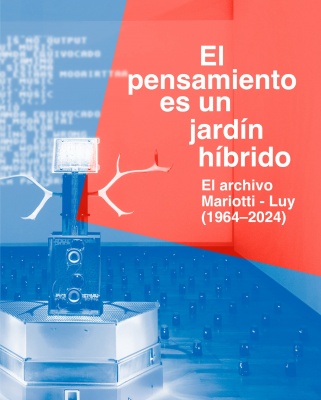
Thinking is a Hybrid Garden: the Mariotti – Luy Archive (1964-2024) showcases six decades of artistic and cultural work by Francesco Mariotti (Bern, Switzerland, 1943) and María Luy (Puerto Maldonado, Peru, 1950), revealing a pioneering body of work that intertwines technology, collectivity, nature, and social commitment. Spread across the galleries of the Museo de Arte de Lima – MALI and the Museo de Arte Contemporáneo de Lima – MAC Lima, this exhibition provides a comprehensive overview on the Mariotti – Luy Archive, currently on loan to MALI. This archive contains historical documentation (photographs, newspaper clippings, magazines, posters, films, and other materials) spanning from the 1960s to the present, covering key moments in both local and international cultural production. Alongside these documents, numerous artworks trace the trajectory of both artists between Peru and Europe.
The exhibition takes as its point of departure the concept of the hybrid, a central theme in the artistic and cultural production of both artists. For Mariotti, the hybrid is not merely a mixture of elements, but rather a complex form of existence that integrates seemingly opposing components, such as technology and nature. The concept derives from his installations known as Hybrid Gardens (or Quantum Gardens), in which distinct elements converge. For the artist, the hybrid is linked to plastic, waste, and consumer culture, as well as to magic, poetry, and art. It is both artificial and natural, and both organic and synthetic. In other words, it embodies a practice of resistance and transformation.
At a time when artificial intelligence (AI) poses new challenges regarding the relationship between humanity, technology, and nature, this exhibition offers a close look at several pioneering developments in this field. We present works that have never before been exhibited in Peru, offering multisensory and luminous experiences. These early projects foreshadow the evolution of artificial intelligences emerging in dialogue with diverse cultural traditions and worldviews, from Dadaism to Amazonian mythologies. The exhibition also highlights cultural management work that has been the driving force behind the prolific creative production of Francesco Mariotti and María Luy.
Co-Curated with Miguel A. López