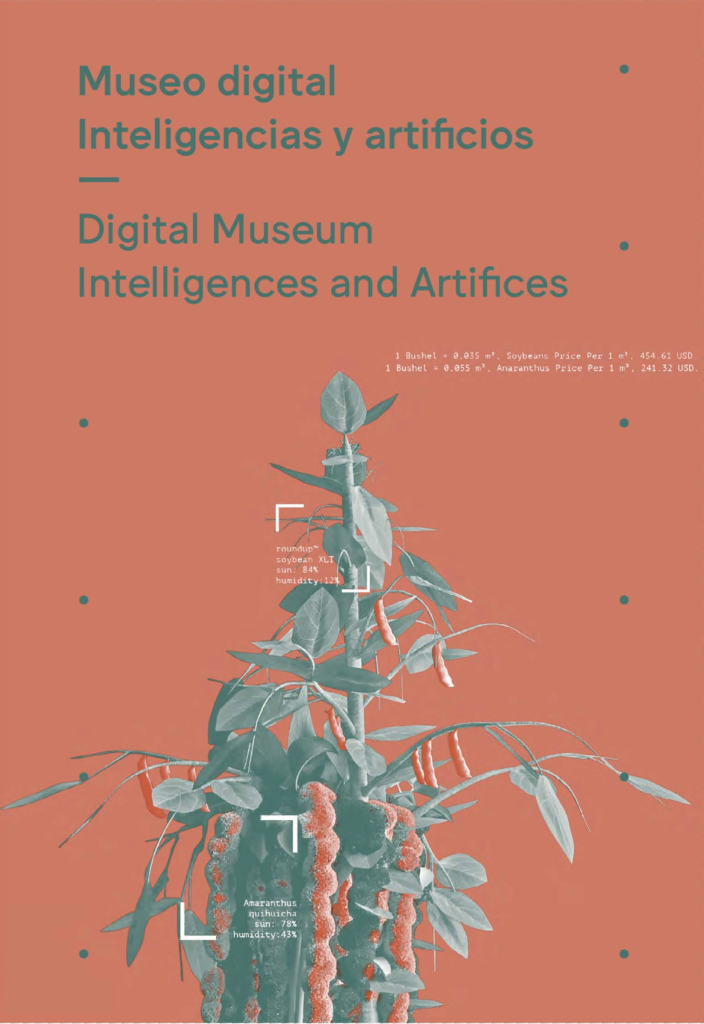
Digital Museum. Intelligences and Artifices

This bilingual edition explores the role of museums in the digital age, with a special focus on exploring and discussing digital practices and global perspectives; it also recognizes the rich history of art and technology in the region. The publication is structured in two main sections: «Future Technologies: Memory, Languages and Knowledges”, discussing indigenous knowledge systems and their relationship with new technologies; and, «The Museum as Laboratory: Technology, Data and New Artistic Practices”, exploring how museums can function as laboratories for knowledge and experimentation.   Both topics aim at discussing not only the impact of digitalisation and technology in museums, but mostly, how the museum should be reconfigured for the 21st century challenges. 

Museo Digital: inteligencias y artificios / Digital Museum. Intelligences and Artifices is published by Museo Universitario Arte Contemporáneo (MUAC) of the National Autonomous University of Mexico (UNAM) with the support of Telefónica Movistar Foundation México.  

Book edited by José-Carlos Mariátegui (Peru/UK).
Contributors include: Sara Diamond (Canada), Ulises Mejías (Mexico/USA), Roberto Zariquiey (Peru), Priscilla Molina Muñoz (Costa Rica), Fernanda Pita (Brazil), Yásnaya Elena Gil (Mexico), Bruno Moreschi (Brazil), Bernardo Fontes (Brazil), Luz María Bedoya (Peru), Juan Cortés (Colombia), and Luis Martínez-Uribe (Spain).   

Available on open access in Spanish and English 

This book emerged from the third edition of the International Digital Museum Conference, which I curated and brought together artists, researchers, and cultural managers to reimagine museums in the digital era.


Mariátegui, José-Carlos, ed. 2025. Digital Museum. Intelligences and Artifices. Edited by José-Carlos Mariátegui. Mexico: Museo Universitario Arte Contemporáneo – MUAC, Universidad Nacional Autónoma de México – UNAM.

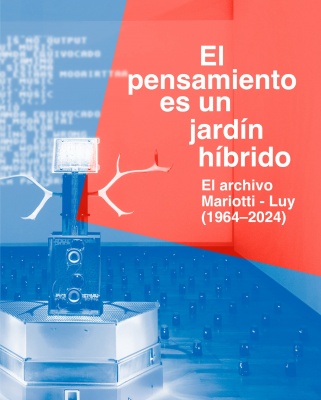
Thinking is a Hybrid Garden: the Mariotti – Luy Archive (1964-2024)

Thinking is a Hybrid Garden: the Mariotti – Luy Archive (1964-2024) showcases six decades of artistic and cultural work by Francesco Mariotti (Bern, Switzerland, 1943) and María Luy (Puerto Maldonado, Peru, 1950), revealing a pioneering body of work that intertwines technology, collectivity, nature, and social commitment. Spread across the galleries of the Museo de Arte de Lima – MALI and the Museo de Arte Contemporáneo de Lima – MAC Lima, this exhibition provides a comprehensive overview on the Mariotti – Luy Archive, currently on loan to MALI. This archive contains historical documentation (photographs, newspaper clippings, magazines, posters, films, and other materials) spanning from the 1960s to the present, covering key moments in both local and international cultural production. Alongside these documents, numerous artworks trace the trajectory of both artists between Peru and Europe.

The exhibition takes as its point of departure the concept of the hybrid, a central theme in the artistic and cultural production of both artists. For Mariotti, the hybrid is not merely  a mixture of elements, but rather a complex form of existence that integrates seemingly opposing components, such as technology and nature. The concept derives from his installations known as Hybrid Gardens (or Quantum Gardens), in which distinct elements converge. For the artist, the hybrid is linked to plastic, waste, and consumer culture, as well as to magic, poetry, and art. It is both artificial and natural, and both organic and synthetic. In other words, it embodies a practice of resistance and transformation.

At a time when artificial intelligence (AI) poses new challenges regarding the relationship between humanity, technology, and nature, this exhibition offers a close look at several pioneering developments in this field. We present works that have never before been  exhibited in Peru, offering  multisensory and luminous experiences. These early projects foreshadow the evolution of artificial intelligences emerging in dialogue with diverse cultural traditions and worldviews, from Dadaism to Amazonian mythologies. The exhibition also highlights cultural management work that has been the driving force behind the prolific creative production of Francesco Mariotti and María Luy.

Co-Curated with Miguel A. López

Hidden Histories of Technology and Cybernetics in Latin America

Techno-oligarchs treat computation as a tool for consolidating power, extracting value, and scaling control — but there is a suppressed history where technology was imagined as something radically different, and this happened in Latin America.

In this piece for UMBAU, the online journal of HfG Karlsruhe, I trace how the region’s engagement with cybernetics was never a simple transplant of Western ideas into tropical soil, but an original intellectual project that integrated technology with local socio-political conditions in ways that remain remarkably relevant today — from Manuel Sadosky’s Marxist vision of computation as liberation in Argentina, to Waldemar Cordeiro’s pioneering computer art as a tool for social transformation in Brazil, to the Bariloche Foundation’s Latin American World Model, which challenged MIT’s «Limits to Growth» from the perspective of those already living in crisis.

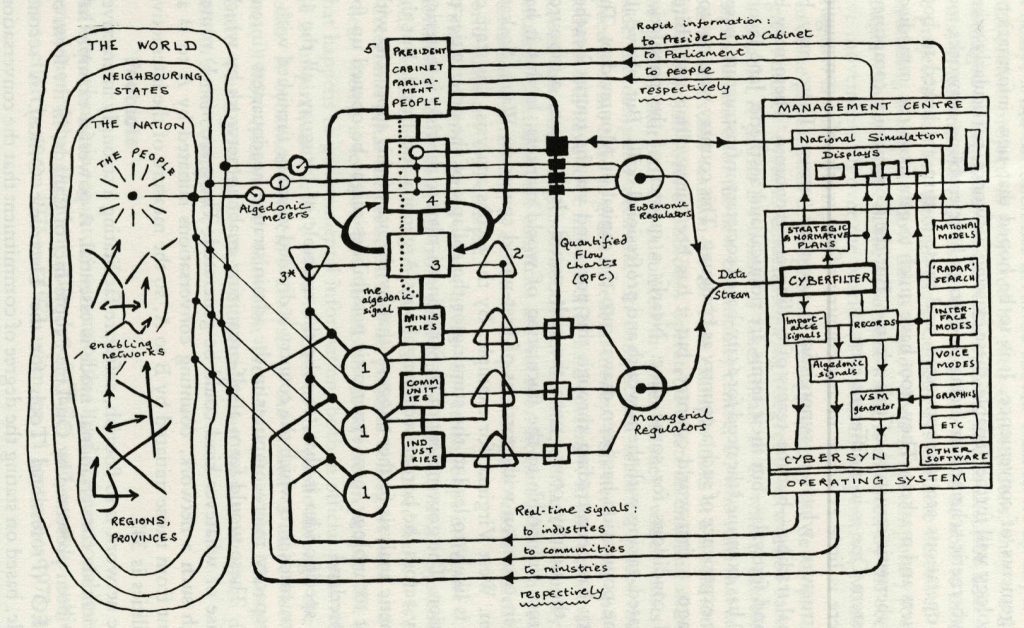
Beyond these, the piece recovers lesser-known experiments like CENTRO in Peru — where exiled intellectuals attempted a «Model of Cybernetic Socialism» — and URUCIB in Uruguay, a locally built Executive Information System for the presidency that anticipated real-time dashboards and early warning detection decades before Silicon Valley made them standard. Where today’s tech billionaires design systems that make citizens into members of global digital platforms while eroding the capacity to ask structural questions about society, these Latin American projects sought the opposite: collective exploration, democratic participation, and local autonomy through cybernetic thinking. Perhaps what we have most lost is not the technology itself but the systemic perspective — the ability to recognise that what a system does, rather than what it claims to do, reveals its true purpose.

Read the full piece (open access)


Mariátegui, José-Carlos. 2026. «Hidden Histories of Technology and Cybernetics in Latin America.» UMBAU (Issue Five: Hide and Seek). https://umbau.hfg-karlsruhe.de/posts/hidden-histories-of-technology-and-cybernetics-in-latin-america.

Limitations of the Linnaean categorization model in the age of Al

Much of the current conversation around AI focuses on bias, ethics, and governance — but rarely does it dig into the history of categories themselves and their lasting impact.

In this paper in the Cambridge Forum on AI: Culture and Society, Juan Cortés and I argue that Linnaean classification — rigid hierarchies and fixed labels — has quietly become the template for how we structure data, metadata, and annotation pipelines, systematically sidelining Indigenous knowledge systems that have understood nature as a living web of relationships for millennia. The categories shaping how we train models were designed in the 18th century to sort and control the natural world.

Drawing on Buffon’s dynamic vision of nature, Kakataibo taxonomies from the Peruvian Amazon, K’iche’ Maya maize cosmology, and other ethnobiological systems from Latin America, we argue why a new classification built on multiplicity, relationality, and cultural context, rather than fixed schemas, what we call rhizomatic hylomorphism, generates living maps where meaning emerges from relationships rather than predetermined labels.

Read the full piece (open access)


Cortes, Juan, and José-Carlos Mariátegui. 2026. «Limitations of the Linnaean categorization model in the age of AI.» Cambridge Forum on AI: Culture and Society 2 (AI & Archives): e5. https://doi.org/10.1017/cfc.2025.10010.

Cambridge Forum on AI: Culture and Society, Themed Issue: AI & Archives
Guest edited by Katie Mackinnon, Louis Ravn, Nanna Thylstrup Joo Eun Seo and Caroline Bassett.

Electro-Poet-Rivelazionaria: Il Salvataggio delle Poesie Computazionali di Gianni Toti – Una conversazione con Francesco Mariotti