Hidden Histories of Technology and Cybernetics in Latin America

Techno-oligarchs treat computation as a tool for consolidating power, extracting value, and scaling control — but there is a suppressed history where technology was imagined as something radically different, and this happened in Latin America.

In this piece for UMBAU, the online journal of HfG Karlsruhe, I trace how the region’s engagement with cybernetics was never a simple transplant of Western ideas into tropical soil, but an original intellectual project that integrated technology with local socio-political conditions in ways that remain remarkably relevant today — from Manuel Sadosky’s Marxist vision of computation as liberation in Argentina, to Waldemar Cordeiro’s pioneering computer art as a tool for social transformation in Brazil, to the Bariloche Foundation’s Latin American World Model, which challenged MIT’s «Limits to Growth» from the perspective of those already living in crisis.

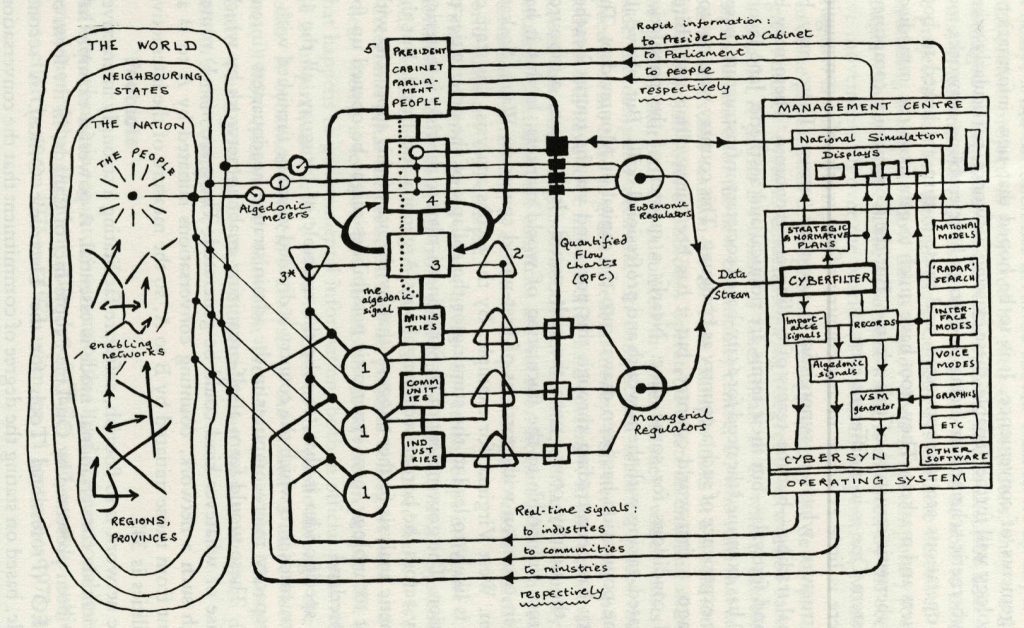
Beyond these, the piece recovers lesser-known experiments like CENTRO in Peru — where exiled intellectuals attempted a «Model of Cybernetic Socialism» — and URUCIB in Uruguay, a locally built Executive Information System for the presidency that anticipated real-time dashboards and early warning detection decades before Silicon Valley made them standard. Where today’s tech billionaires design systems that make citizens into members of global digital platforms while eroding the capacity to ask structural questions about society, these Latin American projects sought the opposite: collective exploration, democratic participation, and local autonomy through cybernetic thinking. Perhaps what we have most lost is not the technology itself but the systemic perspective — the ability to recognise that what a system does, rather than what it claims to do, reveals its true purpose.

Read the full piece (open access)


Mariátegui, José-Carlos. 2026. «Hidden Histories of Technology and Cybernetics in Latin America.» UMBAU (Issue Five: Hide and Seek). https://umbau.hfg-karlsruhe.de/posts/hidden-histories-of-technology-and-cybernetics-in-latin-america.
How to Non-Organize

This piece was a contribution to the book and the main theme of Lisbon Triennale 2025 How Heavy is a City?, curated by John Palmesino, Ann-Sofi Rönnskog of Territorial Agency which was also published in e-flux Architecture, as part of the Lisbon Architecture Triennale’s «Intensification» series.

Here I trace how Italian industrialist Aurelio Peccei — shaped by his years building Fiat Concord in Argentina — arrived at the idea of the Club of Rome as a deliberate «non-organization»: not an institution but a permeable intellectual ecosystem designed to operate across the very boundaries that Cold War logic insisted were insurmountable. What’s been largely forgotten is that this non-organizational structure is precisely what allowed the Bariloche Foundation to emerge as a radical counter-proposal to the research comissioned by the Club of Rome to MIT: Limits to Growth. Bariloche Foundation’s Latin American World Model challenged Limits to Growth ecological catastrophism from the perspective of those already living in crisis, and pioneering the basic human needs framework that the UN system later adopted without credit. Over fifty years later, with climate breakdown, technological governance, and inequality either prevailing or worsening, the question is not whether we need new solutions but whether we need new forms of collective thinking — as diverse and complex as the challenges they seek to address.

Intensification is a collaboration between e-flux Architecture and the Lisbon Architecture Triennale within the context of its seventh edition, “How heavy is a city?,” curated by John Palmesino and Ann-Sofi Rönnskog (Territorial Agency).
Editors Nick Axel, Nikolaus Hirsch, John Palmesino, Ann-Sofi Rönnskog
Contributors John Tresch, Michaela Büsse, Mark Williams, Jan Zalasiewicz, Laura Tripaldi, Kate Crawford, Michael Marder, Geoff Manaugh, Tim Lenton, Raqs Media Collective, and more…

Read the full piece (free access)


Mariátegui, José-Carlos. 2025. «How to Non-Organize.» E-Flux Architecture, no. Intensification. https://www.e-flux.com/architecture/intensification/6782956/how-to-non-organize.

Also published in paperback: How Heavy is a City?, edited by John Palmesino, Ann-Sofi Rönnskog and Territorial Agency, 199-211. Lisbon: Lisbon Triennale 2025.