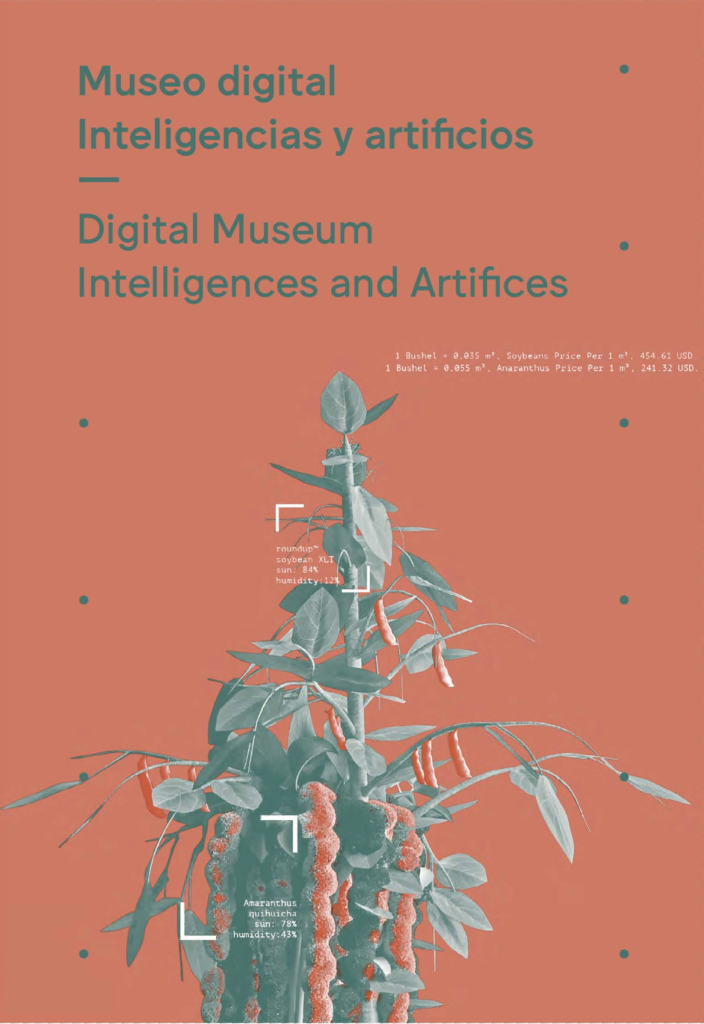
Digital Museum. Intelligences and Artifices

This bilingual edition explores the role of museums in the digital age, with a special focus on exploring and discussing digital practices and global perspectives; it also recognizes the rich history of art and technology in the region. The publication is structured in two main sections: «Future Technologies: Memory, Languages and Knowledges”, discussing indigenous knowledge systems and their relationship with new technologies; and, «The Museum as Laboratory: Technology, Data and New Artistic Practices”, exploring how museums can function as laboratories for knowledge and experimentation.   Both topics aim at discussing not only the impact of digitalisation and technology in museums, but mostly, how the museum should be reconfigured for the 21st century challenges. 

Museo Digital: inteligencias y artificios / Digital Museum. Intelligences and Artifices is published by Museo Universitario Arte Contemporáneo (MUAC) of the National Autonomous University of Mexico (UNAM) with the support of Telefónica Movistar Foundation México.  

Book edited by José-Carlos Mariátegui (Peru/UK).
Contributors include: Sara Diamond (Canada), Ulises Mejías (Mexico/USA), Roberto Zariquiey (Peru), Priscilla Molina Muñoz (Costa Rica), Fernanda Pita (Brazil), Yásnaya Elena Gil (Mexico), Bruno Moreschi (Brazil), Bernardo Fontes (Brazil), Luz María Bedoya (Peru), Juan Cortés (Colombia), and Luis Martínez-Uribe (Spain).   

Available on open access in Spanish and English 

This book emerged from the third edition of the International Digital Museum Conference, which I curated and brought together artists, researchers, and cultural managers to reimagine museums in the digital era.


Mariátegui, José-Carlos, ed. 2025. Digital Museum. Intelligences and Artifices. Edited by José-Carlos Mariátegui. Mexico: Museo Universitario Arte Contemporáneo – MUAC, Universidad Nacional Autónoma de México – UNAM.
Hidden Histories of Technology and Cybernetics in Latin America

Techno-oligarchs treat computation as a tool for consolidating power, extracting value, and scaling control — but there is a suppressed history where technology was imagined as something radically different, and this happened in Latin America.

In this piece for UMBAU, the online journal of HfG Karlsruhe, I trace how the region’s engagement with cybernetics was never a simple transplant of Western ideas into tropical soil, but an original intellectual project that integrated technology with local socio-political conditions in ways that remain remarkably relevant today — from Manuel Sadosky’s Marxist vision of computation as liberation in Argentina, to Waldemar Cordeiro’s pioneering computer art as a tool for social transformation in Brazil, to the Bariloche Foundation’s Latin American World Model, which challenged MIT’s «Limits to Growth» from the perspective of those already living in crisis.

Beyond these, the piece recovers lesser-known experiments like CENTRO in Peru — where exiled intellectuals attempted a «Model of Cybernetic Socialism» — and URUCIB in Uruguay, a locally built Executive Information System for the presidency that anticipated real-time dashboards and early warning detection decades before Silicon Valley made them standard. Where today’s tech billionaires design systems that make citizens into members of global digital platforms while eroding the capacity to ask structural questions about society, these Latin American projects sought the opposite: collective exploration, democratic participation, and local autonomy through cybernetic thinking. Perhaps what we have most lost is not the technology itself but the systemic perspective — the ability to recognise that what a system does, rather than what it claims to do, reveals its true purpose.

Read the full piece (open access)


Mariátegui, José-Carlos. 2026. «Hidden Histories of Technology and Cybernetics in Latin America.» UMBAU (Issue Five: Hide and Seek). https://umbau.hfg-karlsruhe.de/posts/hidden-histories-of-technology-and-cybernetics-in-latin-america.

How to Non-Organize

This piece was a contribution to the book and the main theme of Lisbon Triennale 2025 How Heavy is a City?, curated by John Palmesino, Ann-Sofi Rönnskog of Territorial Agency which was also published in e-flux Architecture, as part of the Lisbon Architecture Triennale’s «Intensification» series.

Here I trace how Italian industrialist Aurelio Peccei — shaped by his years building Fiat Concord in Argentina — arrived at the idea of the Club of Rome as a deliberate «non-organization»: not an institution but a permeable intellectual ecosystem designed to operate across the very boundaries that Cold War logic insisted were insurmountable. What’s been largely forgotten is that this non-organizational structure is precisely what allowed the Bariloche Foundation to emerge as a radical counter-proposal to the research comissioned by the Club of Rome to MIT: Limits to Growth. Bariloche Foundation’s Latin American World Model challenged Limits to Growth ecological catastrophism from the perspective of those already living in crisis, and pioneering the basic human needs framework that the UN system later adopted without credit. Over fifty years later, with climate breakdown, technological governance, and inequality either prevailing or worsening, the question is not whether we need new solutions but whether we need new forms of collective thinking — as diverse and complex as the challenges they seek to address.

Intensification is a collaboration between e-flux Architecture and the Lisbon Architecture Triennale within the context of its seventh edition, “How heavy is a city?,” curated by John Palmesino and Ann-Sofi Rönnskog (Territorial Agency).
Editors Nick Axel, Nikolaus Hirsch, John Palmesino, Ann-Sofi Rönnskog
Contributors: Anne McClintock, Emanuele Coccia, Soundwalk Collective, Patti Smith, Andrew Pickering, Lívia Nolasco-Rózsás, Paul N. Edwards, José-Carlos Mariátegui, Raqs Media Collective, Tim Lenton, Geoff Manaugh, Michael Marder, Kate Crawford, Laura Tripaldi, Mark Williams, Jan Zalasiewicz, Michaela Büsse and John Tresch

Read the full piece (free access)


Mariátegui, José-Carlos. 2025. «How to Non-Organize.» E-Flux Architecture, no. Intensification. https://www.e-flux.com/architecture/intensification/6782956/how-to-non-organize.

Also published in paperback: How Heavy is a City?, edited by John Palmesino, Ann-Sofi Rönnskog and Territorial Agency, 199-211. Lisbon: Lisbon Triennale 2025.

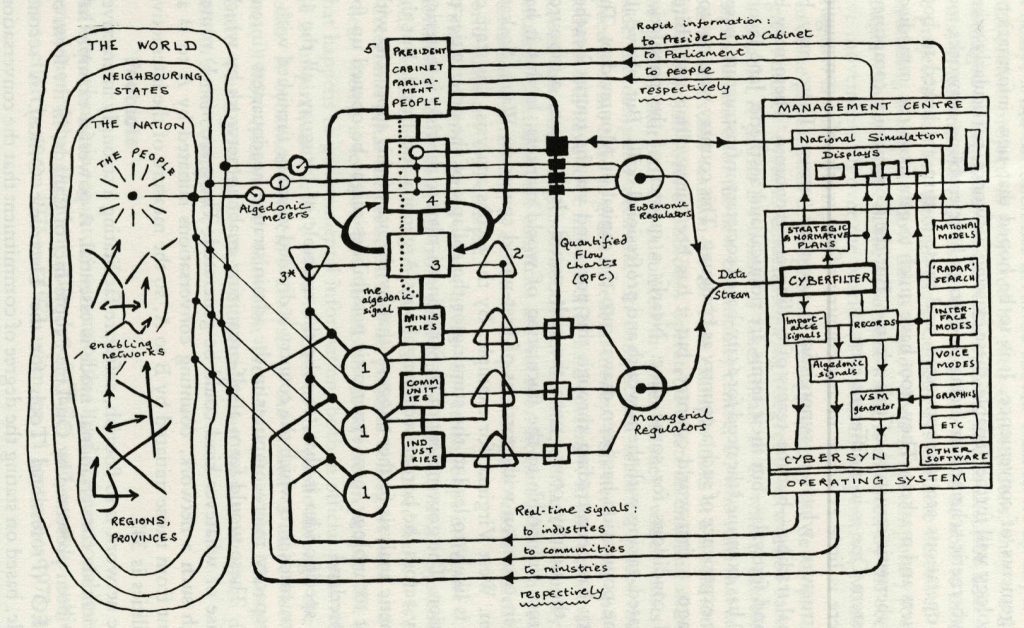
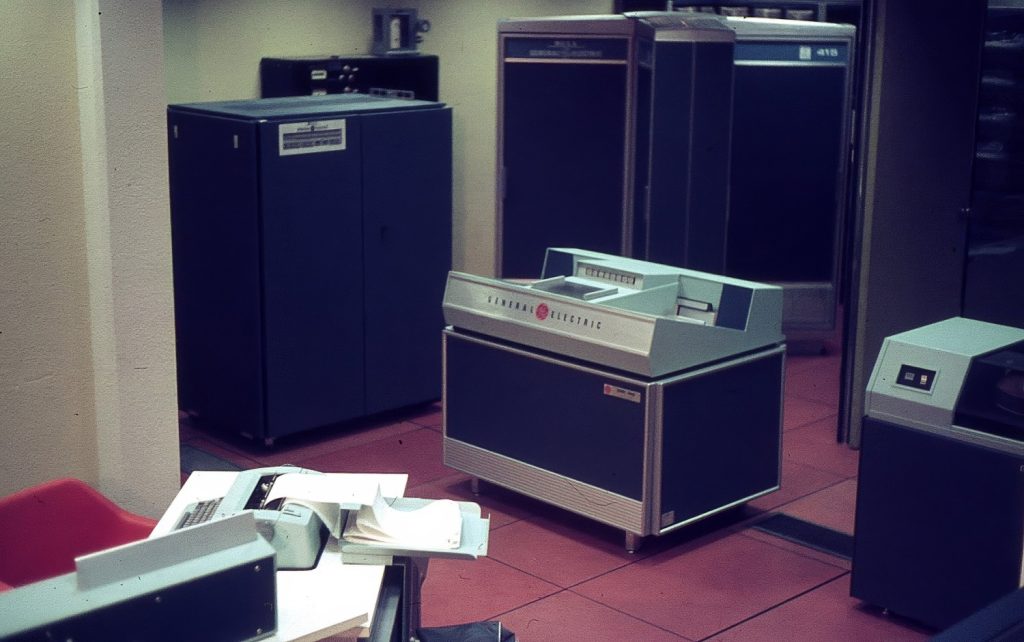
Beyond Project Cybersyn: Tracing the Influence of Stafford Beer Projects and Ideas in Latin America

This research paper explores Stafford Beer’s lesser-known journeys and collaborations in Latin America beyond the well-known Chilean project Cybersyn. It traces Beer’s involvement in the region back to the 1960s through his company SIGMA and its projects in Chile, as well as its attempts to expand into other Latin American countries. The paper also sheds light on a relatively unknown project in the 1970s in Peru, the Centre for the Study of People’s Participation (CENTRO), which was influenced by Beer’s ideas on real-time enterprise information and control systems. Furthermore, it explores Beer’s involvement in various projects across Latin America during the 1980s and 1990s, as the region gradually returned to democracy, including cases in Mexico, Uruguay (URUCIB), Venezuela (Cybervenez), and Colombia. While some implementations, particularly in Uruguay and Colombia, demonstrated the Viable System Model’s (VSM) potential for fostering genuine organizational democracy and social transformation, others in Mexico and Venezuela failed due to political instability or systemic corruption. The paper argues that though Beer’s VSM is often characterized as purely technocratic, its implementation in Latin America reveals that while sometimes appropriated by neoliberal reforms, it also aligned with regional aspirations for social transformation and creative liberation through the use of technology, challenging persistent biases about where technological innovation can originate.

This paper is part of an ongoing research on the history of cybernetics, which is mostly based on archival research and oral histories. I am particularly grateful to Carlos de Senna Figueiredo and Angela Espinosa, who have contributed with invaluable information ever since I started this research. I am also grateful to the Stafford Beer Collection at Liverpool John Moores University (Emily Parsons) and the team at Darcy and Berta Ribeiro Archive at the University of Brasilia (José Ronaldo Cunha, Katiane Brito and Janaina Dos Santos Melo), as well as to the ILO Archives in Geneva (Jacques Rodriguez). For this research, I interviewed a number of people to whom I am grateful: Víctor Ganón, Joan Garcés, Allenna Leonard, and Francisco Sagasti.

Read the full piece (open access)


Mariátegui, José-Carlos. 2025. «Beyond Project Cybersyn: Tracing the Influence of Stafford Beer Projects and Ideas in Latin America.» Systemic Practice and Action Research 38 (2): 9. https://doi.org/10.1007/s11213-025-09717-2. https://doi.org/10.1007/s11213-025-09717-2.