ARTEÔNICA is an exhibition project that explores the little-known Latin American art movement based on the relationship between art, science and technology, from the 1960s up to the present.
Arteônica: Art, Science and Technology in Latin America Today takes as its starting point the unparalleled contribution of Brazilian electronic art pioneer Waldemar Cordeiro (Italy, 1925 – Brazil, 1973)— one of the first computer artists in South America — to explore and analyze the state of electronic and cybernetic arts in the last 60 years. Cordeiro’s treatise on arteônica—a verbal synthesis of electronic art and the original title of the exhibition he held in Brazil in 1971—features the computer as an instrument for positive social change capable of democratizing art and culture.
In that sense, Arteônica explores this little-known Latin American art movement, creating a dialogue between a group of «pioneers» from the 1960s and 1970s and the contemporary artists whose work responds to their legacy.
In spite of Latin America’s challenging political and social conflicts of the 1960s and 1970s — coups d’état, civil – military dictatorships, economic crises — the relationship between art, science and technology expanded during that period, both in aesthetic theories and in artistic productions.
Latin American artists and thinkers never stopped working at the intersection of art, science and technology, enriching the historical legacy with compelling contemporary debates on participation, social engagement, Indigenous knowledge, living and autonomous systems, memory, and networks for global solidarity, leading to uncommon terrains giving rise to critical and dialogical perspectives.
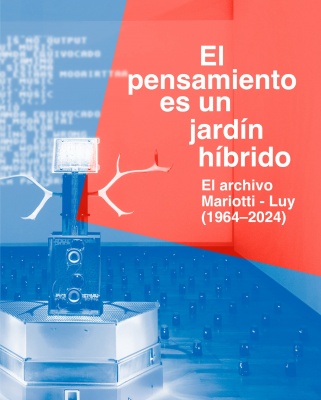
Artists such as Marta Minujín (Argentina), Francesco Mariotti (Peru), Juan Downey (Chile), Gyula Kosice (Argentina), Martha Boto (Argentina), Pola Weiss (Mexico), and Teresa Burga (Peru) laid the foundations for a production inspired by the most innovative concepts of their time, while submerging themselves in international and local research findings, the ideas that moved the world, and those emerging from their own regional milieux.
The 21st century sees many of those pioneering artists and numerous other Latin American artists and thinkers working at the intersection of art, science and technology: Analivia Cordeiro (computerized dance / Brazil), Marcela Armas (autonomous ecological technology / Mexico), Constanza Piña (free software and open designs / Chile), Mariano Sardón (unlearning structures from neurosciences / Argentina), Rejane Cantoni (machine linguistics / Brazil), Patricia Domínguez (art, ethnobotany, and non-human intelligence / Chile), Juan Salas Carreño (animation with the use of digital tools / Peru), Leo Nuñez (bio art, interactive objects and robotics / Argentina), Tania Candiani (intersection of sound and multimedia / Mexico), Vitória Cribb (animation and 3D / Brazil), Lucía Monge (link between humans and plants / Peru), and Dora Bartilotti (activism / Mexico).
Fully inscribed in the present, Arteônica: Art, Science and Technology in Latin America Today sets out to draw a succinct panorama of some of the most relevant contributions of science-and-technology art made by Latin American artists today, and to restore some solidity to an aesthetic and intellectual framework that may allow placing those contributions in a broader, conceptual, historical, and geopolitical intellectual setting.
From the hypothesis that links artists to their specific social and cultural contexts (this is the case for many Latin American creators who maintain a special bond with their places of origin while living in other regions), we set out to develop an exhibition environment and a conceptual framework—in the form of theoretical research—that enabled us to address what is intrinsic to the technological arts arising from Latin America.
To this end, we have brought forth two levels of progressively converging work. On one hand, a group of artists whose oeuvre lies at the intersection of art, science and technology develop a proposal in dialogue with their exchanges with scientists, engineers, technicians, and other agents, many of them central contributors to that field’s growth and experimentation. On the other hand, a group of Latin American theorists and researchers contribute a complete revision of that context through an approach that restores and amplifies the links between past and present.
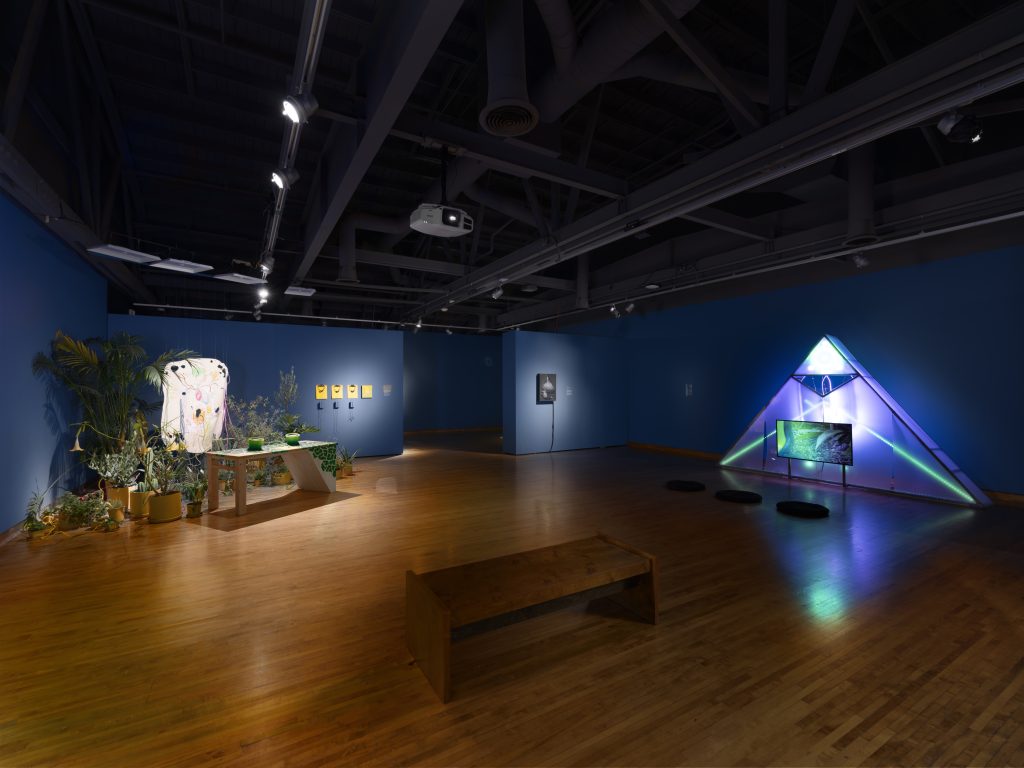
The exhibition is presented as a knowledge and experimentation matrix exploring themes as a cross-section—not chronologically but in dialogue with these interrelated thematic axes where many of the artists could be part of each of the nuclei in question from different perspectives.