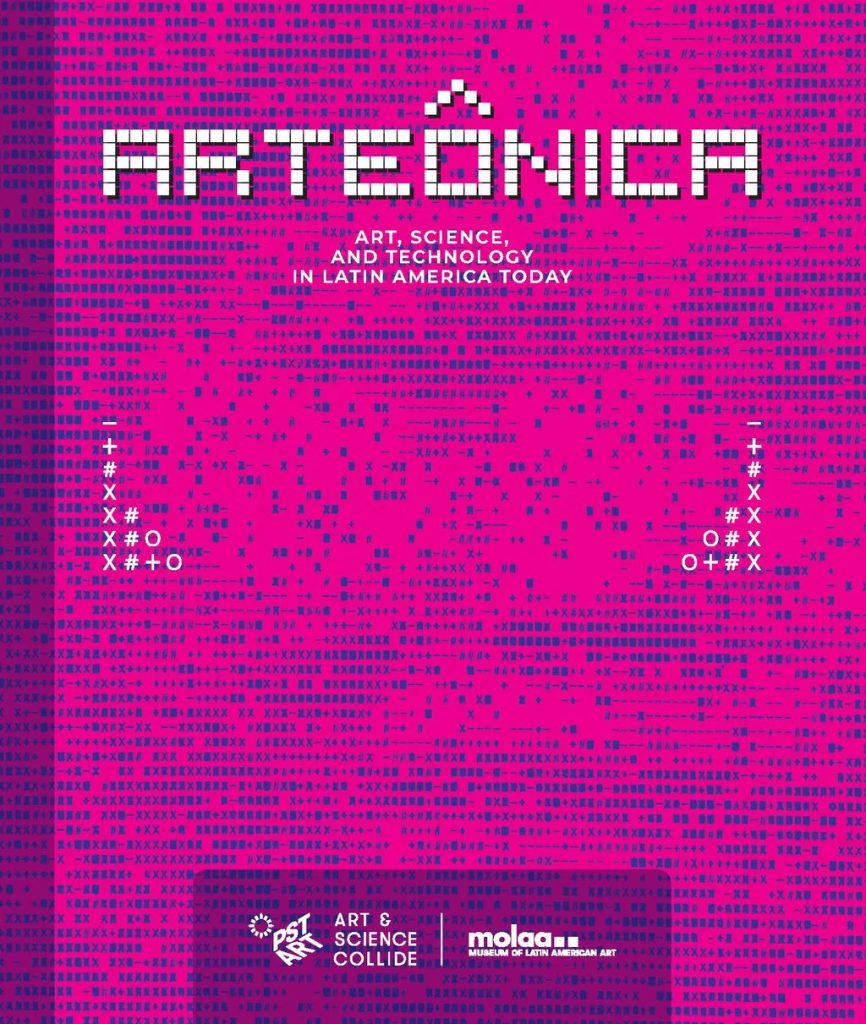
ARTEÔNICA: Art, Science, and Technology in Latin American Today, Exhibition Catalog

WINNER of the 2026 ALAA-Thoma Foundation Exhibition Catalogue Award! Learn more about the award HERE

*****

MOLAA´s Exhibition Catalog book / Hardcover

Edited by Gabriela Urtiaga (MOLAA´s Chief Curator) with contributions by José-Carlos Mariátegui, Rodrigo Alonso, Claudia Giannetti, Patrick Frank, Tania Aedo Arankowsky, and David Maulén de los Reyes.

Product description

ARTEONICA is a Museum of Latin America´s catalog exhibition dedicated to explore the links between art, science and technology in Latin America from the 1960s to the present. This book, published in conjunction with a major exhibition at MOLAA, presents a comprehensive study about this little-known Latin American art movement, creating a dialogue between a group of “pioneers” artists from the 1960s and 1970s and the contemporary artists whose work responds to their legacy.

Artists from Argentina, Brazil, Chile, Mexico and Peru: Marcela Armas, Dora Bartilotti, Martha Boto, Teresa Burga, Tania Candiani, Rejane Cantoni, Analivia Cordeiro, Waldemar Cordeiro, Vitória Cribb, Patricia Domínguez, Juan Downey, Gyula Kosice, Francesco Mariotti, Marta Minujín, Lucía Monge, Leo Nuñez, Constanza Piña, Juan Salas Carreño, Mariano Sardón and Pola Weiss.

An outstanding group of writers offer diverse essays addressing key threads about the intersection of art, science and technology, enriching the historical legacy with compelling contemporary debates on participation, social engagement, Indigenous knowledge, living and autonomous systems, memory, and networks for global solidarity, leading to uncommon terrains giving rise to critical and dialogical perspectives.


Product details
Publisher ‏ : ‎ The Museum of Latin American Art (MOLAA) 
Language ‏ : ‎ English-Spanish
Hardcover ‏ : ‎ 248 pages fully illustrated 
ISBN : ‎ 978-0-9801080-7-1
Dimensions ‏ : ‎ 9 x 1.1 x 10.5 inches
Publication date: November 20th, 2024
Hidden Histories of Technology and Cybernetics in Latin America

Techno-oligarchs treat computation as a tool for consolidating power, extracting value, and scaling control — but there is a suppressed history where technology was imagined as something radically different, and this happened in Latin America.

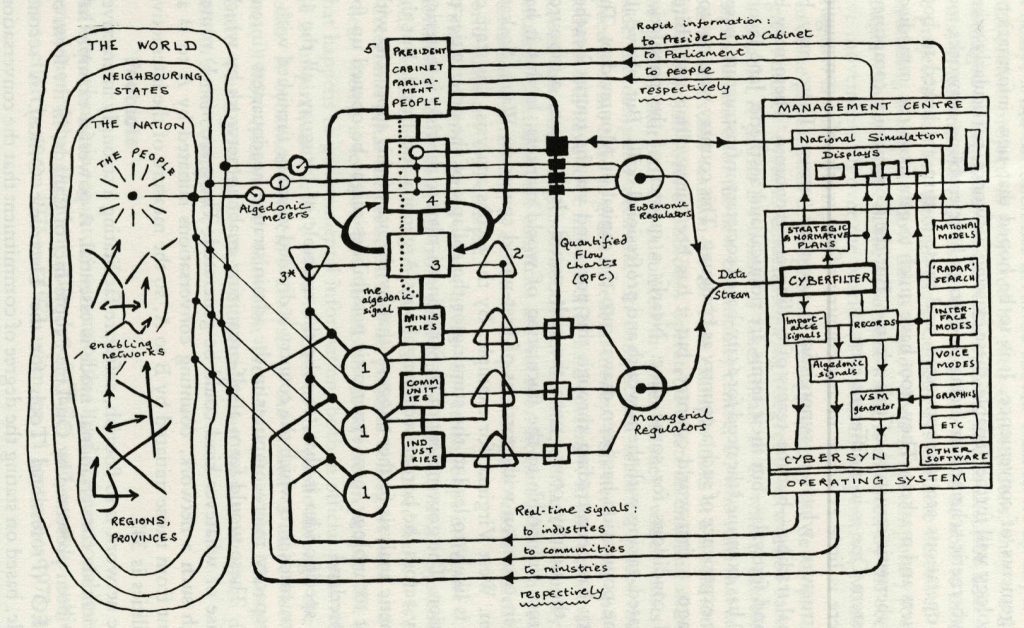
In this piece for UMBAU, the online journal of HfG Karlsruhe, I trace how the region’s engagement with cybernetics was never a simple transplant of Western ideas into tropical soil, but an original intellectual project that integrated technology with local socio-political conditions in ways that remain remarkably relevant today — from Manuel Sadosky’s Marxist vision of computation as liberation in Argentina, to Waldemar Cordeiro’s pioneering computer art as a tool for social transformation in Brazil, to the Bariloche Foundation’s Latin American World Model, which challenged MIT’s «Limits to Growth» from the perspective of those already living in crisis.

Beyond these, the piece recovers lesser-known experiments like CENTRO in Peru — where exiled intellectuals attempted a «Model of Cybernetic Socialism» — and URUCIB in Uruguay, a locally built Executive Information System for the presidency that anticipated real-time dashboards and early warning detection decades before Silicon Valley made them standard. Where today’s tech billionaires design systems that make citizens into members of global digital platforms while eroding the capacity to ask structural questions about society, these Latin American projects sought the opposite: collective exploration, democratic participation, and local autonomy through cybernetic thinking. Perhaps what we have most lost is not the technology itself but the systemic perspective — the ability to recognise that what a system does, rather than what it claims to do, reveals its true purpose.

Read the full piece (open access)


Mariátegui, José-Carlos. 2026. «Hidden Histories of Technology and Cybernetics in Latin America.» UMBAU (Issue Five: Hide and Seek). https://umbau.hfg-karlsruhe.de/posts/hidden-histories-of-technology-and-cybernetics-in-latin-america.